Daily uptime
100.00%27 OctToday
No downtimePartial (95–99.9%)Major (below 95%)
Response time
avg 440 ms26 Oct 03:0507 Nov 03:0824 Nov 23:57
- Status
- Up
- Last response
- 200521 ms
- Checked
- Every 2 minutes
- Last check
- 14 mins ago
 Live · checked 14 mins ago
No, AWS is up.
AWS is responding normally. Last checked 14 mins ago, with 100.00% uptime over the last 30 days and an average response time of 440 ms.
Daily uptime and response times from SIOPS checks. Hover a bar or the chart for details.
Report what you’re seeing. Visitor reports help show whether a problem with AWS is widespread or only affecting a few people, even before our checks pick it up.
This page shows live, independent monitoring for AWS. SIOPS requests aws.amazon.com every 2 minutes and records whether each check succeeds and how fast it responds.
The status at the top reflects the most recent check. Uptime is the share of successful checks per day, and response time is how long AWS’s servers took to answer. Short dips can come from brief network issues; sustained red bars usually mean a real outage.
The cards and charts at the top of this page show the result of our latest request to AWS's main site. Read Last Updated before you trust them. If that time is well behind the check interval, our data is lagging, so give the AWS Health Dashboard more weight until it catches up.
AWS runs hundreds of services across many regions, and problems usually hit one service in one region, not all of AWS. Your own resources live in the regions you chose. So when people search "is AWS down", the real question is usually whether a specific service in their region is affected, or whether their own setup is the cause.
The uptime chart tells you whether AWS's main site replied to each check. The response time chart tells you how fast. That's the public website, not the console or the services your apps use. AWS services can have regional problems while these charts look fine.
A lone spike usually reflects the route between our checker and AWS. A cluster of slow checks deserves attention. Use the 7, 15 and 30 day views to see whether today is unusual.
We request AWS's main site from servers in more than one region, outside Amazon's network, on a fixed interval. A short problem between checks may not appear.
Green means the website answered. We don't sign in to the console, call any AWS service or check any region. Your applications need their own monitoring for that.
AWS runs the AWS Health Dashboard at health.aws.amazon.com/health/status. It shows the status of AWS services by region. Signed in, your account's health view also shows events that affect your own resources. Use both with ours. Our charts show whether AWS's main site answers from outside. The dashboard shows which service and region AWS has confirmed is affected.
Regional incidents affect one service in one region, and anything depending on it there. Apps built in a single region feel those most.
Your own setup causes many failures: permission changes, security group rules, expired certificates, hitting service limits, or a deploy that changed behaviour. Those look like AWS problems but sit in your account. Dependencies between services mean one issue can show up as errors in another.
Check the AWS Health Dashboard for your region and service. Problems are usually limited to one region.
Sign in and open your account's health view. It lists events that affect your resources.
Check your credentials and multi factor method, then the dashboard for sign in issues.
They're separate. Amazon shopping has its own page here.
Your IAM permissions don't allow that action. Check the role or policy attached to the request.
SIOPS, an independent uptime monitoring service, runs these checks. We aren't affiliated with Amazon or AWS, and the results on this page come from our own requests to AWS's main site, not from the AWS Health Dashboard.
No, AWS is up. This is based on SIOPS’s latest check at 24 Nov 2026, 18:27 UTC. The status updates automatically as new checks come in.
AWS is responding normally to our checks, so the problem may be limited to your network, region, device or account. Try switching networks, updating the app, clearing its cache or signing out and back in.
Use the “Report a problem” form on this page: choose where you noticed it (app, website, API, login, notifications, payments or something else) and describe what went wrong. You can leave your email if you’d like an update. Reports from visitors help show whether an issue is affecting everyone or just a few people.
SIOPS checks aws.amazon.com every 2 minutes from outside AWS’s network and records the response code and response time of every check.
AWS has had 100.00% uptime over the last 30 days, with an average response time of 440 ms.
Uptime is the percentage of successful checks over a period. 99.9% uptime over 30 days means about 43 minutes of downtime that month.
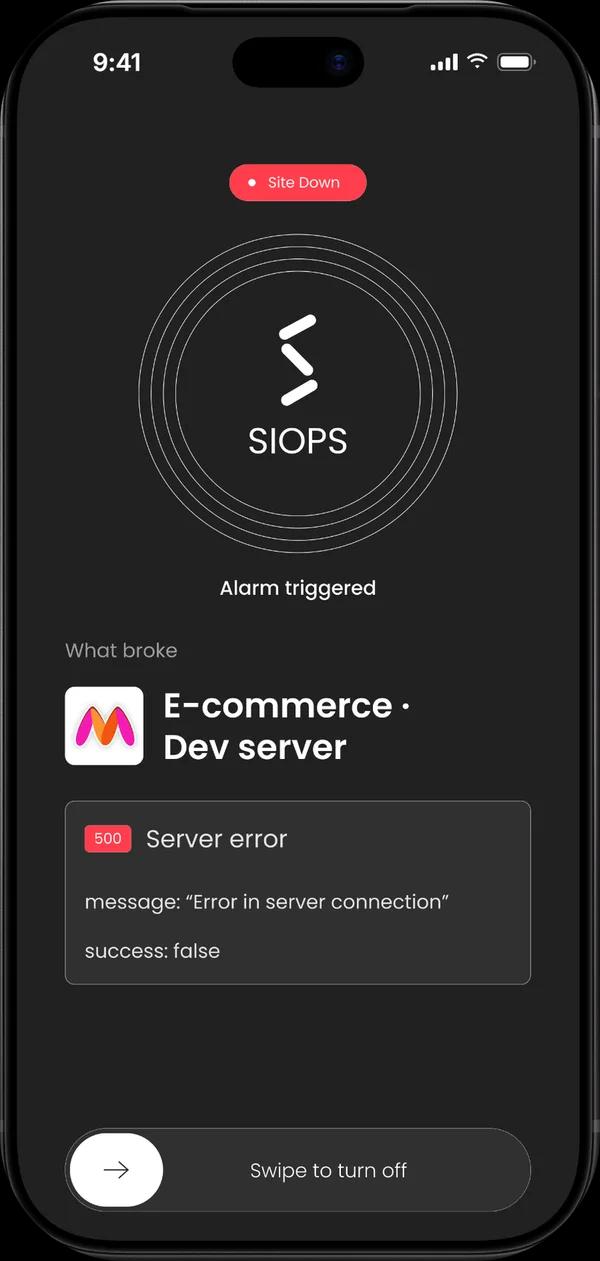
Install the SIOPS app on iOS or Android to monitor your own websites and servers with loud alarms that bypass Silent Mode, plus Slack, email, phone call, push and webhook alerts.
Checking AWS is free. Monitor your own websites, APIs and servers and SIOPS will ring like an alarm the moment they go down.